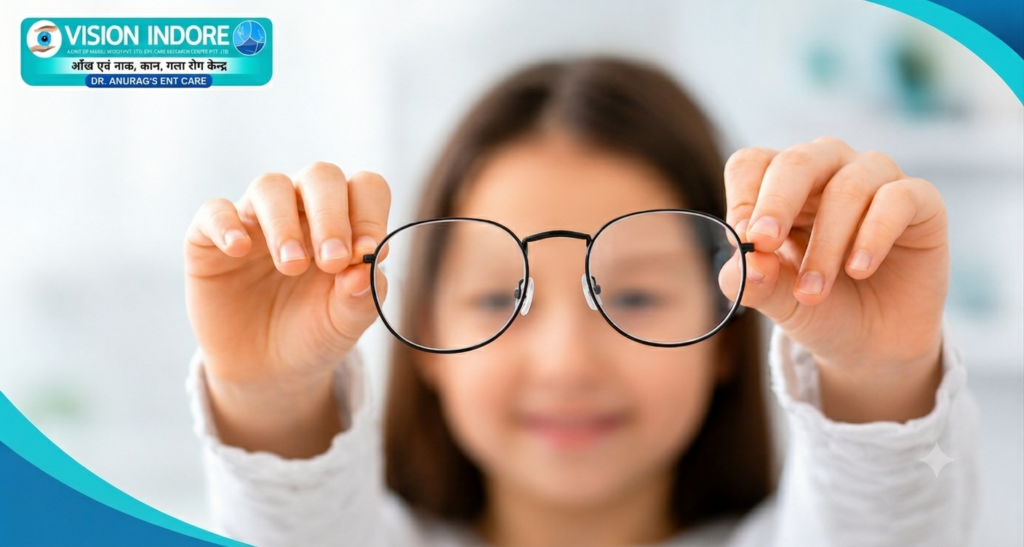
When a child gets glasses for the first time, most parents hope the prescription will remain the same for years. But sometimes, during the next eye check-up, they hear that the glasses number has increased again.
This can make parents worried.
“Why is my child’s eyesight getting weaker every year?”
“Is too much screen time responsible?”
“Will my child need stronger glasses every year?”
These are common concerns. The good news is that an increasing glasses number does not always mean there is a serious eye problem. Children’s eyes continue to grow and develop, and conditions such as myopia can change during childhood.
However, regular eye examinations are important. Consulting a Best Eye Speccilist Doctor in Indore can help parents understand why their child’s prescription is changing and what steps may help manage the condition.

What Does an Increasing Glasses Number Mean?
The “glasses number” refers to the prescription required to help the eyes focus clearly.
One common reason for an increasing prescription in children is myopia, also known as short-sightedness. A child with myopia may see nearby objects clearly but have difficulty seeing things that are far away.
As the child’s eyes grow, myopia can sometimes become stronger. This is why parents may notice that their child needs a new prescription after regular eye check-ups.
A Best Eye Specialist Doctor in Indore can examine the child’s vision and determine whether the prescription is changing because of normal eye development, myopia progression, or another eye-related issue.
Why Is My Child’s Glasses Number Increasing?
There can be several reasons behind changing eyesight in children.
1. Natural Growth of the Eyes
Children’s eyes are still developing. During the growing years, changes in the size and shape of the eyeball can affect how light focuses on the retina.
For some children, this can result in increasing myopia.
Regular appointments with a Best Eye Specialist Doctor in Indore allow parents to monitor these changes instead of waiting until their child starts struggling to see.
2. Too Much Near Work
Children spend a lot of time doing activities that require close vision.
Homework, reading, tablets, smartphones, computers and other close-up activities can keep children focusing at a short distance for long periods.
Near work is not the only reason a child’s glasses number may increase, but prolonged close-up activities combined with limited outdoor time may contribute to myopia development and progression.
A Best Eye Specialist Doctor in Indore can help parents understand how their child’s daily habits may affect their eye health.
3. Less Outdoor Time
Think about your child’s daily routine.
School in the morning, homework in the afternoon, tuition in the evening, and screen time at night can leave very little time for outdoor activities.
Spending more time outdoors is associated with a lower risk of developing myopia in children. Encouraging outdoor play can therefore be a useful part of healthy eye habits.
A Best Eye Specialist Doctor in Indore may also recommend lifestyle changes along with regular vision monitoring.
4. Family History
Genetics can also influence a child’s risk of developing myopia.
If one or both parents have myopia, the child may have a higher risk of developing it as well. This does not mean that every child with myopic parents will have increasing glasses numbers, but family history is an important factor.
During an eye examination, a Best Eye Specialist Doctor in Indore can consider the child’s family history along with their current prescription and eye health.
5. Delayed Eye Check-Ups
Some children adapt surprisingly well to blurry vision.
A child may not complain because they think the way they see is normal. They may simply sit closer to the television or classroom board.
When an eye examination is delayed, a change in prescription may go unnoticed.
Regular examinations with a Best Eye Specialist Doctor in Indore can help identify changes earlier and keep track of the child’s vision.

Signs That Your Child May Need an Eye Check-Up
Parents should pay attention to small changes in everyday behaviour.
Your child may need an eye examination if they:
- Squint when looking at distant objects
- Sit very close to the television
- Hold books or phones too close
- Have difficulty reading the classroom board
- Frequently rub their eyes
- Complain of headaches after reading
- Avoid activities that require distance vision
- Frequently complain that things look blurry
- Struggle to see clearly without glasses
If you notice these signs, consider scheduling an appointment with a Best Eye Specialist Doctor in Indore rather than simply replacing your child’s glasses without an examination.
Can Screen Time Make the Glasses Number Increase?
This is one of the biggest questions parents ask.
Screens are now part of children’s education and daily life, so completely avoiding them may not always be realistic.
Instead, parents can focus on healthier screen habits.
Encourage children to take regular breaks, maintain a comfortable viewing distance and spend time outdoors every day.
The 20-20-20 rule can also be useful during prolonged near work: after around 20 minutes, encourage your child to look at something about 20 feet away for approximately 20 seconds.
A Best Eye Specialist Doctor in Indore can provide additional advice based on your child’s age, prescription and eye health.
How Can Parents Help Protect Their Child’s Eyes?
Small daily habits can make a difference.
Encourage Outdoor Play
Make outdoor activities a regular part of your child’s routine. Walking, cycling, playing sports or simply spending time outside can reduce the amount of continuous near work during the day.
Take Regular Screen Breaks
Children should not spend several hours continuously looking at a screen. Encourage breaks between homework, gaming, online classes and entertainment.
Maintain Proper Reading Distance
Teach children to avoid holding books, phones or tablets extremely close to their face.
Keep Regular Eye Appointments
If your child already wears glasses, regular examinations are especially important.
A Best Eye Specialist Doctor in Indore can compare previous and current prescriptions and determine whether the child’s myopia is stable or progressing.
What Treatment Is Available for Increasing Myopia?
Treatment depends on the child’s age, prescription, rate of progression and overall eye health.
Simply changing to stronger glasses helps the child see clearly, but it does not necessarily stop myopia from progressing.
For children with progressing myopia, an eye specialist may discuss specific myopia-management approaches. Depending on the individual case, these may include specially designed contact lenses, orthokeratology or certain low-dose atropine treatments.
These options are not suitable for every child.
A Best Eye Specialist Doctor in Indore can examine the child and explain which options may be appropriate, including their potential benefits, limitations and follow-up requirements.
Parents should never start eye drops, contact lenses or other treatments without professional guidance.
When Should Parents Consult an Eye Specialist?
If your child’s prescription is increasing every year, it is worth discussing the change with an eye-care professional.
You should particularly seek an examination if your child experiences:
- A rapid change in vision
- Difficulty seeing the classroom board
- Persistent headaches related to visual tasks
- Frequent squinting
- Eye discomfort
- Sudden blurry vision
- Flashes or a sudden increase in floaters
- Significant or sudden loss of vision
For sudden or severe changes in vision, seek prompt medical attention.
A Best Eye Specialist Doctor in Indore can assess the child’s eyes and help determine whether the change is part of normal myopia progression or requires further evaluation.
A Simple Step Parents Can Take Today
Imagine your child sitting in the classroom and slowly moving closer to the board because the writing is becoming difficult to see.
At home, they sit closer to the television and hold their phone closer than before.
These small signs can easily be overlooked.
Instead of waiting until your child complains, make regular eye examinations part of their healthcare routine.
If you are searching for a Best Eye Specialist Doctor in Indore consider factors such as professional qualifications, experience in children’s eye care, examination facilities, approach to myopia management and communication with parents.
The goal should not simply be to give your child stronger glasses. The goal is to understand why the prescription is changing and how your child’s vision can be monitored properly.
An increasing glasses number can be concerning, but early attention and regular monitoring can help parents make informed decisions about their child’s eye health.
Frequently Asked Questions
1. Why does my child’s glasses number increase every year?
One common reason is myopia progression as the child’s eyes continue to grow. Genetics, lifestyle and other factors can also contribute.
2. Can mobile phones increase my child’s glasses number?
Extended near work and screen use may be associated with myopia risk, particularly when combined with limited outdoor time. Regular breaks and outdoor activities are helpful habits.
3. Can myopia in children be controlled?
Some treatments and lifestyle measures may help slow myopia progression in suitable children. An eye-care professional can recommend an approach based on the child’s individual condition.
4. How often should my child have an eye examination?
The schedule depends on the child’s age, prescription and eye health. Children with changing prescriptions may require more frequent monitoring.
5. Should my child wear glasses throughout the day?
This depends on the prescription and the eye specialist’s recommendation. Follow the instructions provided during the eye examination.
6. How do I find a Best Eye Specialist Doctor in Indore?
Look for a qualified eye-care professional with appropriate experience in children’s eye examinations and myopia management. Consider qualifications, experience, examination facilities, and the treatment approach.
7. Will my child’s eyesight definitely become worse every year?
No. Every child’s eyes develop differently. Some prescriptions remain stable, while others change during childhood. Regular eye examinations can help monitor these changes.
8. Can outdoor activities help children’s eyesight?
Spending time outdoors has been associated with a lower risk of developing myopia in children. Outdoor activity should be combined with appropriate eye examinations and professional advice.


